Issue No. 01 — Is VC a Trap?

Welcome to the inaugural issue of Dispatches—a monthly newsletter for founders, investors, and allies. Each Dispatches issue editorializes around a single idea, draws on practitioners and real examples to show how it works in practice, and points founders toward resources worth exploring.
Istarted my career as a banker—not the kind whose name appears in Barron's, but the kind who sat across from corporate and institutional clients and structured debt. Term loans, revolving credit facilities, and subordinated notes. That was the vocabulary of business finance, and it served a purpose.
After years inside the startup ecosystem, one thing was consistent. Seed rounds, Series A, cap tables, dilution—founders spoke this language as though it were the only one that existed. The pitch deck had replaced the balance sheet. The VC partner had replaced the loan officer.
I haven't come full circle. I'm not arguing for debt only, nor am I a convert to the equity-only gospel. What I am is a pragmatist. And the near-total dominance of equity thinking among early-stage founders is not just limiting. Founders can spend months chasing a term sheet instead of building their business—and if they close the round, it can narrow every decision that follows.
In 2025, venture and growth investors deployed $425 billion into more than 24,000 private companies globally.1 That sounds enormous until you hold it against the denominator: only 0.05% of startups raise venture capital.2 The U.S. alone contains 36.2 million small businesses.3 The gap between who receives equity and who needs capital is the defining financial reality for the vast majority of founders.
1. Crunchbase, January 2026. 2. Fundera, via DemandSage, 2026. 3. U.S. Small Business Administration, Office of Advocacy, 2025 Small Business Profile.
Lead Insight
The Funding Reflex Founders Can't Shake
Founders pursue institutional venture capital not always because it is the right instrument, but because it is the most visible one. When equity is all you see, equity is all you consider.
Institutional VC is structurally designed for a narrow set of outcomes: hypergrowth, large addressable markets, and exits measured in multiples. For founders building durable, profitable businesses outside that profile, accepting that capital often means accepting a trajectory that was never theirs to begin with.
Before you raise, ask two questions: Why am I raising? And when do I actually need the money? The answers—alongside an honest read of your revenue and financial position—may point somewhere other than a term sheet.
Debt instruments, government programs, revenue-based structures, and working capital tools each serve a different purpose—and most carry no equity dilution at all. What follows is a practical map of those options.
Financing Options
Non-Equity Financing Vehicles
Eleven vehicles worth understanding before you open a pitch deck.
Bank Loans
Term Loans & Commercial Credit
Traditional financing issued by commercial banks and credit unions, typically requiring two or more years of operating history, positive cash flow, and personal or business collateral. Interest rates are generally lower than alternative lenders, and repayment terms run from one to ten years. Best suited for established businesses with predictable revenue that need capital for expansion, equipment, or working capital without diluting equity.
Patagonia (the apparel company) relied on bank debt and reinvested earnings rather than venture capital throughout its growth, allowing founder Yvon Chouinard to retain full ownership and control for decades.
Bridge Loan
Debt & Equity
Short-term capital designed to cover a gap between a current need and an anticipated future event—a closing round, a contract payment, or an acquisition. May include a convertibility clause if structured as equity-adjacent. Expensive by design; should be used sparingly and with a clear exit from the bridge in view.
Bridge loans are common in pre-IPO and pre-acquisition situations across industries. They are most effective when the triggering event is concrete and near-term; they become problematic when used to delay hard decisions about a company's viability.
Crowdfunding
$1.2B Funding Volume in 2023
Regulated under the JOBS Act, crowdfunding allows founders to raise small amounts from a large pool of backers. Success requires a compelling story, a gamified campaign structure, and a community-ready product. Software companies rarely win here; physical products and consumer brands tend to perform best. The PR value can be as significant as the capital raised.
Oculus VR raised $2.4 million on Kickstarter in 2012—ten times its $250,000 goal—validating consumer demand for virtual reality before the company had a single retail partner. That traction contributed directly to Facebook's $2 billion acquisition two years later.
Factoring
Accounts Receivable / Improve Working Capital
Factoring involves selling outstanding invoices outright to a third-party factor, who then collects payment directly from your customers. The business receives 70–85 percent of the invoice value upfront; the factor retains the remainder as its fee once the invoice is collected. The key distinction from invoice financing is the transfer of collection responsibility—the factor owns the receivable. Best suited for B2B businesses with creditworthy customers and consistent invoicing volume.
Factoring is the dominant working capital tool in the staffing and trucking industries. Staffing firms routinely factor payroll-period invoices to bridge the gap between funding weekly payroll and collecting on net-60 client terms—enabling them to accept larger contracts without taking on debt.
Invoice Financing
Accounts Receivable / Improve Working Capital
Invoice financing allows a business to borrow against the value of its outstanding invoices while retaining ownership and collection responsibility. Advances typically run 70–90 percent of the invoice face value; the lender is repaid once the customer pays. Unlike factoring, the customer relationship remains with the business—customers are unaware of the arrangement. Useful for businesses that want to accelerate cash flow without ceding control of collections.
Clearco (formerly Clearbanc) built its model around invoice financing for e-commerce and SaaS companies, funding more than 7,000 businesses with over $3 billion in non-dilutive capital by advancing against outstanding invoices and future receivables without taking equity.
Lines of Credit
Secured & Unsecured
A revolving facility—borrow, repay, borrow again—rather than a fixed loan. Requires revenue, collateral, and positive credit history. Interest rates run higher than traditional loans and penalties apply for overdraws. Useful for managing operational cash flow and short-term gaps.
Lines of credit are the standard working capital tool for retail and seasonal businesses. A retailer drawing on a credit line to stock inventory before peak season—then repaying from sales revenue—is the instrument working exactly as designed: smoothing the gap between outflows and inflows without permanent debt.
Revenue-Based Financing
Investors Required
Capital raised from investors in exchange for a percentage of ongoing gross revenues until a predetermined repayment multiple is reached. Payments flex with revenue—lower in slow months, higher in strong ones. No fixed maturity date. Suited for companies with predictable, recurring revenue who want to avoid equity dilution.
Pipe, founded in 2019, built a platform connecting SaaS companies to investors willing to advance capital against annual recurring revenue. By 2022, more than 22,000 companies had connected to the platform, representing over $7 billion in ARR—demonstrating the scale of founder demand for non-dilutive, revenue-aligned capital.
SBA Loan
7(a), 504, Microloan
Applied for through SBA-approved banks, with approval timelines around three months. Borrow up to $5MM, guaranteed by the Small Business Administration. Covers startup costs and property acquisition. Requires a personal guarantee and must meet SBA size and business-type standards.
In 2005, Hamdi Ulukaya used an $800,000 SBA 504 loan to purchase a defunct Kraft yogurt factory in upstate New York. That single instrument launched Chobani—a company that reached $1 billion in annual sales within five years and now carries a valuation exceeding $20 billion.
SBIR & STTR
Up to $150,000 (Phase I)
US federal grant programs for small businesses engaged in R&D. SBIR grants are provided by 11 agencies; STTR grants require collaboration with a non-profit research institution and are available through 5 agencies. Phase I awards reach up to $150,000. Non-dilutive and renewable into Phase II.
iRobot accumulated more than $16 million in SBIR and STTR funding from the Army, Navy, and DARPA to develop military robotics technology. The autonomous navigation systems built for defense applications became the technical foundation of the Roomba consumer vacuum—one of the best-selling consumer robotics products in history. Qualcomm similarly traced its earliest outside capital to SBIR awards, which co-founder Irwin Jacobs credited as a critical factor in the company's formation.
Vendor Financing
Debt & Equity
Financing provided directly by a supplier or vendor, enabling a business to acquire essential goods or services without traditional bank involvement. Carries higher interest rates than conventional loans but preserves cash and avoids equity dilution. Often negotiable as part of a procurement relationship.
Vendor financing is most commonly used in capital-equipment-intensive industries—manufacturing, telecom, and logistics—where suppliers extend credit to accelerate adoption of their own products. It is most valuable when the relationship gives a founder leverage to negotiate terms as part of a larger procurement agreement.
Venture Debt
Startups & Fast-Growing Companies
A high-interest loan issued in parallel with equity, provided by specialty lenders. Used to fund R&D, equipment, and business expansion without additional dilution. Best suited for companies that have already closed an equity round and want to extend runway.
Airbnb raised $1 billion in venture debt led by J.P. Morgan, Citigroup, Bank of America, and Morgan Stanley to extend runway and fund operations ahead of its IPO—preserving equity while maintaining growth momentum at a stage where additional dilution would have been costly.
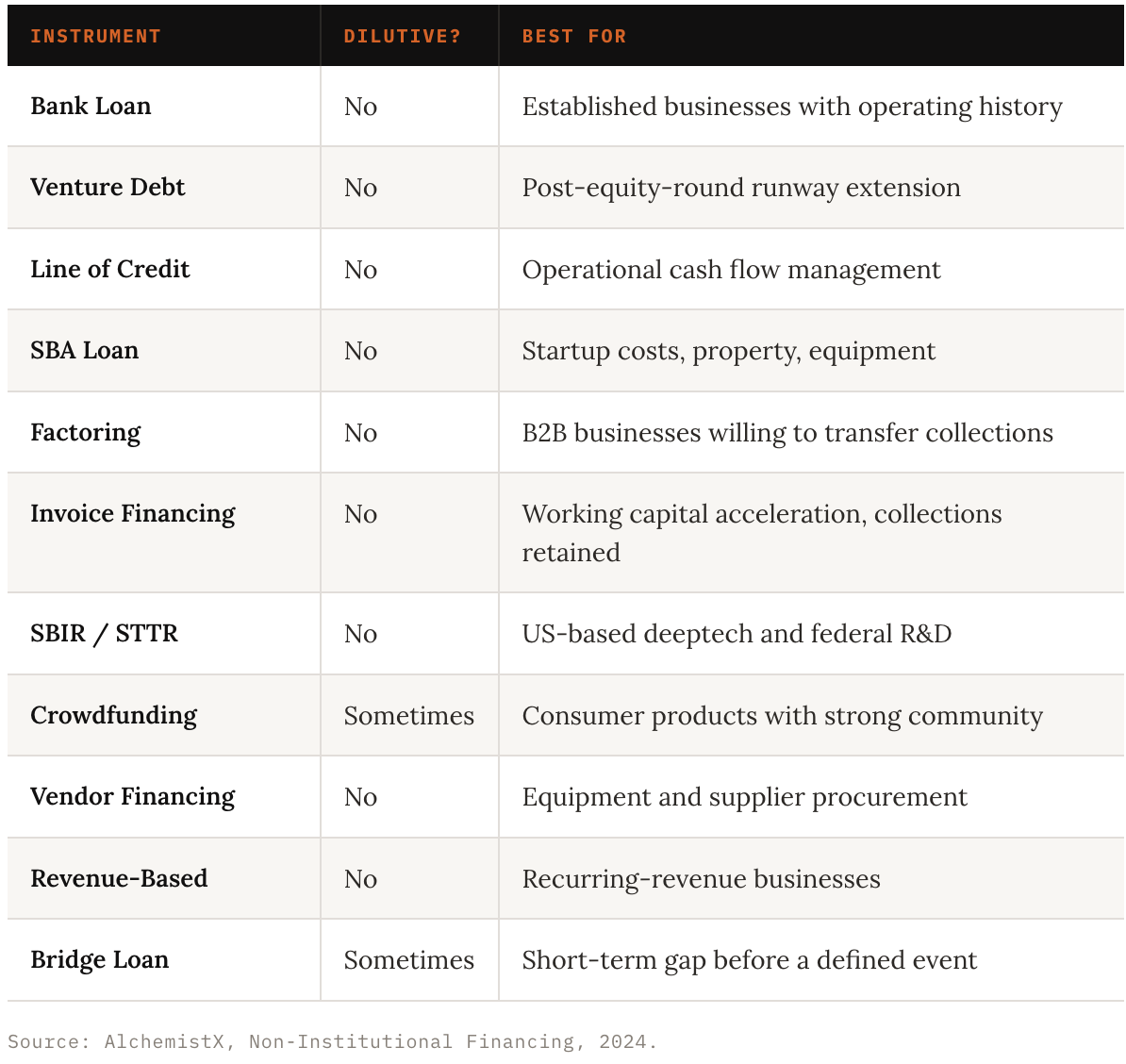
At a Glance
Which Instrument Fits
A quick reference across dilution, stage fit, and primary use.
Decision Framework
Five Questions Before You Raise
- Do I actually need external capital, or do I need better cash flow management?
- Am I raising to survive or to accelerate a proven model?
- How much dilution am I willing to accept—and at what valuation?
- What is my repayment capacity if I take on debt today?
- Is my business eligible for non-dilutive programs I haven't yet explored?
VC isn't always wrong—but it is always a trade. Know what you're trading before you sign.
Resources
More Information
Investopedia →General Finance DefinitionsA broad, plain-language reference for financial and investing terms—the fastest place to look up a definition you only half-remember.
Carta — VC & Equity Glossary →Startup & Equity TermsA glossary built for founders and investors, covering the equity-specific language of fundraising: cap tables, SAFEs, dilution, and preferences.
SBA — Loan Programs →Primary Source · 7(a), 504, MicroloanThe Small Business Administration's own guide to its guaranteed loan programs, including eligibility and lender matching.
SBIR & STTR — America's Seed Fund →Primary Source · Non-Dilutive Federal R&DThe official portal for the federal SBIR and STTR grant programs, with solicitations and eligibility across the participating agencies.
SEC — Regulation Crowdfunding →Primary Source · Reg CFThe Securities and Exchange Commission's reference on the rules that govern raising capital from the public under the JOBS Act.